| Overall strategy and general description The project will follow a service-based approach i.e. the services developed will be integrated in existing e-learning environments and build on the results of open source projects in the area of elearning and language technologies. This will enable us to concentrate on our key tasks i.e. the development of a set of next-generation support and advice services. The services will be the result of an interdisciplinary effort bringing together researchers in the areas of language technology, cognition, technology enhanced learning and pedagogics. To structure the work LTfLL has been designed around three different activity clusters which together integrate the activities of the partners: 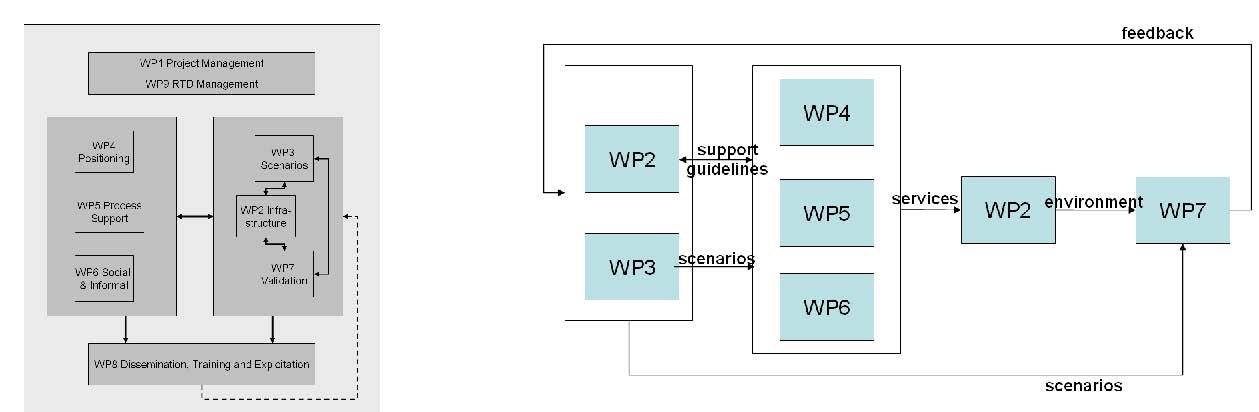
a) Consortium Management Activities (WP1) and RTD Management Activities (WP9) b) Two types of S/T activities: - Integration activities (WP2, 3 and 7)
- S/T activities on language technologies and social software (WP4-6) (Language activities)
c) Valorisation and Sustainability Activities (WP8)
The integration activities are critical for the outcomes of the project. They deal with the requirements and educational perspective of each of the services resulting from the Language Activities, the integration in a learning environment of these services, their usage and their validation through which the further development and adaptation of the services can be directed. Therefore all partners are involved in at least part of the integration activities. In this way the Language Activities are enveloped by activities that ensure common ground in use cases and pedagogically sound scenarios that steer the design and development of the services and guide the validation; a technical infrastructure for the creation and integration of the services and a validation structure that ensures rigorous evaluation in realistic settings, with several languages supported. The Language activities themselves have been organised in three themes, each with two topics. The overall integration management in LTfLL has been derived from the Unified Process that emphasises a detailed and elaborate project cycle management. For LTfLL the application of the Unified Process principles has resulted in a set-up where validation through piloting activities takes a central position: - In the first cycle (inception/elaboration) of 12 months the current state-of-the-art and the technologies the partners bring into the project are the input for the educational scenarios and the integration process for the validation.
- In the second cycle (construction) of 12 months the evaluation results of the pilots and the output of the first cycle of Language Activities will be taken as the input for a set of new and updated scenarios and the integration activities for the validation.
- In the third cycle (transition) of 12 months the evaluation results of the previous pilot runs and the output of the Language Activities is again taken into account as input for this last cycle. The validation results of this round will feed into a roadmap describing how to sustain the results achieved and a proposal for new directions.
|